
Before the calibre debate starts
African hunting has a way of turning sensible riflemen into philosophers. Ask ten experienced hunters for the perfect safari calibre and you may receive twelve answers. The problem is not that any one of them is necessarily wrong. The problem is that calibre conversations often ignore the two things that matter most in the field: bullet placement and bullet construction.
A hunter who shoots a familiar .30-06 calmly from sticks is better equipped for most plains game than a hunter who arrives with a fashionable magnum he has learned to fear. Likewise, a premium controlled-expansion bullet that reaches the vitals from a quartering angle is more useful than impressive muzzle energy paired with a fragile projectile. The goal of this guide is not to declare winners. It is to give a practical range of suitable tools for common African species and explain where optics and field conditions change the decision.
A sensible way to group African game
Instead of building a separate rifle for every animal, think in groups. Light plains game includes species such as springbuck, blesbuck, impala, common reedbuck, duiker and klipspringer. Medium and heavy plains game includes kudu, nyala, waterbuck, hartebeest, wildebeest, zebra, gemsbuck, sable and roan. Eland sits at the large end of the plains-game spectrum. Cape buffalo belongs in the dangerous-game category where legal minimums, specialised bullet design and the PH’s requirements take priority.
For a one-rifle plains-game safari, a familiar 7mm or .30-calibre rifle with premium ammunition covers an enormous amount of ground. A hunter combining very small antelope with eland may prefer two rifles or accept that the bullet chosen for the larger game must be used carefully on the smaller animals.
Optics: Africa does not require a telescope on top of a rifle
Most normal safari shooting happens at ranges where a clear, durable variable-power scope is more useful than extreme magnification. In thick bush, field of view and fast target acquisition matter. In open country, a little extra magnification helps with precise aiming, but it should not come at the cost of a narrow sight picture or complicated controls.
A scope in the broad 2-10x, 2.5-10x or 3-12x family is enough for most plains-game hunters. A dangerous-game rifle benefits from a rugged low-power variable or similarly fast optic with generous eye relief. The exact brand matters less than reliable zero, strong mounts and a reticle the hunter can see quickly in dark animals and mixed light.
1. Impala
Impala are not large, but they are often surrounded by many alert eyes. Deer-class cartridges from the .243 family upward can work where legal and appropriate, though many safari hunters simply use the same 7mm or .30-calibre rifle they carry for the rest of the plains-game bag. Choose an expanding bullet that opens reliably without being excessively fragile.
A versatile mid-power scope is ideal because shots may appear quickly in bush or across more open ground. The challenge is usually not power; it is selecting one ram from a herd and waiting for a clear angle.
2. Blesbuck
Blesbuck are commonly hunted in more open country, which places a premium on wind judgement and a steady rest. Mild to medium flat-shooting cartridges are excellent. The familiar .270, 7mm-08, 7x57, .308 and similar rounds all fit comfortably, while larger .30-calibre rifles work just as well.
A 3-12x-type scope can be useful when the country opens, but there is little reason to chase high magnification. Learn the trajectory of the load you actually bring.
3. Springbuck
Springbuck combine small target size with the possibility of open-country distance. Accuracy and wind reading matter more than large bullet diameter. Mild flat-shooting cartridges with controlled expanding bullets are ideal. Hunters using a general-purpose .30-calibre rifle should choose their shot carefully to avoid unnecessary hide damage.
A clear mid-power optic and a good prone, sitting or supported position are more valuable than raw velocity.
4. Warthog
Warthog can appear suddenly and disappear just as quickly. A medium plains-game cartridge with a sturdy expanding bullet is excellent. The pig’s shoulder structure is heavier than its body size suggests, so avoid lightly constructed bullets that may fail to penetrate on an angled shot.
Keep the scope at a low-to-medium setting while walking in bush. A warthog rarely waits while a hunter turns a magnification ring from 14x back to 4x.
5. Greater kudu
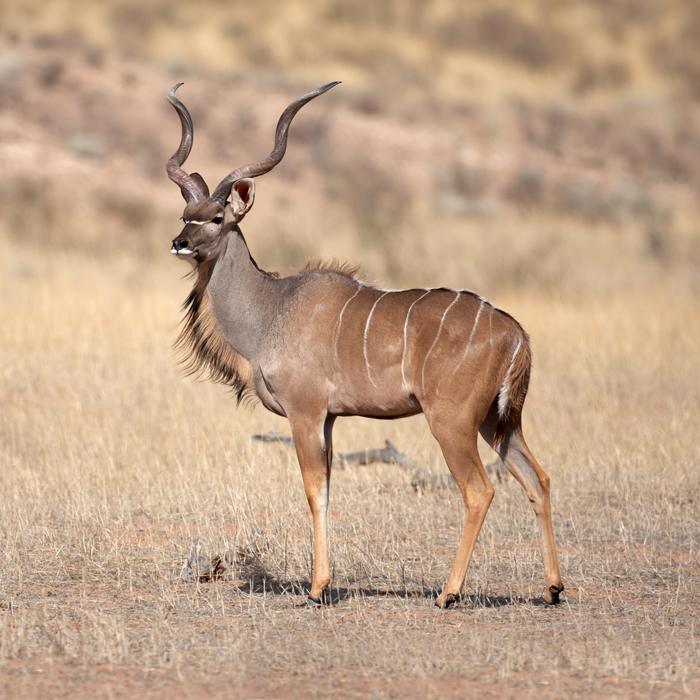
Kudu are large antelope, but the shooting problem is often created by cover rather than body mass. .270-class cartridges, the traditional 7x57, modern 7mm rounds and the standard .30 calibres all have long records on kudu when paired with good bullets. For quartering angles and large bulls, strong controlled expansion gives useful insurance.
A versatile 2-10x or 3-12x scope fits kudu country well. The more important skill is getting onto sticks quietly while the bull is visible.
6. Nyala
Nyala are often hunted in thicker habitat. Medium cartridges in the 7mm and .30-calibre classes are excellent. A bullet that expands reliably without disintegrating through shoulder muscle is preferred.
Optically, field of view matters. A low bottom-end magnification helps when a bull steps into a narrow opening.
7. Bushbuck
Bushbuck are compact but robust antelope, frequently encountered in dense cover or along riverine habitat. The classic deer cartridges are more than sufficient with good bullets. Hunters who are already carrying a .308, .30-06 or similar rifle for the rest of the safari have no reason to change.
A bright, uncomplicated scope on a low setting suits the short windows typical of bushbuck hunting.
8. Waterbuck
Waterbuck are substantially built. Medium .30-calibre cartridges are particularly comfortable choices, though suitable 7mm and .270-class rifles have also taken many cleanly. Premium bullets are worthwhile because the animal may be quartering and because the hair and shoulder can make the body look larger and more forgiving than the vital zone really is.
A standard plains-game optic is ideal.
9. Blue wildebeest
Blue wildebeest deserve a tough bullet and respect. The .308, .30-06 and comparable .30-calibre rifles are natural choices, as are suitable 7mm cartridges with strong bullets. Larger cartridges are not wrong; they are simply unnecessary if the hunter can place a good medium-calibre bullet correctly.
Stay on the exact animal after the shot. A moving herd can quickly turn identification into the more difficult part of the follow-up.
10. Black wildebeest
Black wildebeest are often encountered in more open country. Ballistically, the same general medium-cartridge advice applies as for blue wildebeest. The difference may be the need for steadiness in wind and a clean shot at a slightly longer distance.
A mid-power scope with a reticle you understand in crosswind is more useful than a complex ballistic system you have not practised with.
11. Red hartebeest
Red hartebeest can give open-country opportunities and have a sloping body profile that sometimes misleads first-time hunters. Familiar flat-shooting medium cartridges work well. Use a sturdy expanding bullet and concentrate on anatomy rather than the apparent shape of the shoulder.
A scope in the usual 3-12x range is plenty.
12. Zebra
Zebra are tough, alert herd animals. Many PHs are happiest when clients use .30-calibre rifles with strong controlled-expansion bullets, though suitable 7mm rounds can work very well. The point is reliable penetration and disciplined shot selection.
The stripes can make precise visual reference surprisingly difficult in broken light. Use the reticle deliberately and stay on the selected animal after firing.
13. Gemsbuck
Gemsbuck combine heavy shoulder structure with often-open country. .270-class cartridges and upward work well with premium bullets, while 7mm and .30-calibre rifles are especially common. Avoid choosing a light, explosive bullet purely because the cartridge is flat shooting.
A clear mid-power scope and familiarity with wind are important.
14. Sable
Sable are valuable, impressive antelope but not a special ballistic category. A familiar medium plains-game rifle with a well-constructed expanding bullet is ideal. The hunter’s greater challenge is waiting for the PH to judge maturity and then resisting the urge to rush because the animal looks spectacular.
A standard variable scope suits most sable country.
15. Roan
Roan are large, powerfully built antelope. Medium .30-calibre cartridges are comfortable choices; suitable 7mm cartridges with premium bullets also work. The body deserves the same respect as wildebeest or waterbuck.
Use enough optic to place the bullet precisely without turning the rifle into a heavy bench-rest system.
16. Tsessebe
Tsessebe can live in more open country and may require a steady shot rather than a heavy rifle. Medium flat-shooting cartridges with quality expanding bullets are appropriate.
A practical 3-12x-type optic is useful, provided the hunter has practised field positions and understands wind.
17. Bontebok
Bontebok are moderate-sized antelope. Standard deer and plains-game cartridges work well. For hunters who may export a trophy to a country with species-specific requirements, the paperwork deserves as much attention as the cartridge.
Choose a bullet that is accurate and appropriate for the body size; a huge magnum offers no special advantage.
18. Common reedbuck
Common reedbuck are moderate-sized and generally do not demand heavy recoil. Mild to medium cartridges are ideal. A clear scope that performs well in early or late light can be especially useful because reedbuck activity may favour cooler periods.
19. Mountain reedbuck
Mountain reedbuck place more emphasis on carrying the rifle and shooting from uneven positions. A lighter flat-shooting rifle can be pleasant in hill country. Again, familiar moderate cartridges are enough.
The scope should not make the rifle unnecessarily heavy or top-heavy.
20. Klipspringer
Klipspringer are small, and bullet choice deserves care if cape damage matters. Accuracy is far more important than power. Hunters often use a mild rifle or carefully selected ammunition from a general plains-game rifle.
A precise, clear optic helps on rocky terrain, but magnification should not replace a stable position.
21. Eland
Eland is where many hunters begin considering a step up. Good .30-calibre rifles with heavy premium bullets can work very well. .338, 9.3mm and .375-class rifles provide additional bullet weight and penetration for hunters who shoot them comfortably.
The correct answer is not automatically ‘bigger’. A flinch eliminates the theoretical margin. Use a strong bullet and put it through the vitals.
22. Cape buffalo
Buffalo belongs in a different conversation. The rifle must meet the legal and outfitter requirements for dangerous game. The .375 class is a common baseline for client rifles, with larger traditional dangerous-game cartridges used by hunters who handle them well. Ammunition must be selected specifically for buffalo and tested for feeding and point of impact.
A rugged low-power variable with generous eye relief is often ideal. The first shot should be deliberate; the second should be available immediately.
If you bring one plains-game rifle
A hunter who arrives with a dependable .30-06, .308, 7x57, 7mm-08, .270-class rifle or comparable cartridge and premium hunting ammunition can cover the majority of a normal plains-game list. There is no need to manufacture complexity. Zero it, practise from sticks and know what the bullet does at realistic distance.
The most African rifle is the one that is in your hands, loaded with ammunition you trust, when the PH whispers, ‘That is the bull.’
Waidmannsheil Safaris — Real hunting. Real Africa.